
This post was updated on May 28, 2026
Lyme disease can be difficult to recognize in children, especially when they do not develop the classic bull’s-eye rash that many parents and doctors expect to see. According to the Children’s Lyme Disease Network, children and adolescents account for approximately 25% of reported Lyme disease cases each year, with children between ages 5–15 considered among the highest-risk groups. (childrenslymenetwork.org)
Many Lyme-literate practitioners and organizations, including ILADS (International Lyme and Associated Diseases Society), warn that Lyme disease in children is often missed because symptoms can be vague, fluctuate, or mimic other conditions. Fewer than 50% of patients remember a tick bite, and many children never develop or notice a rash. Some sources report that less than 10% of children recall seeing the classic bull’s-eye rash at all. (childrenslymenetwork.org)
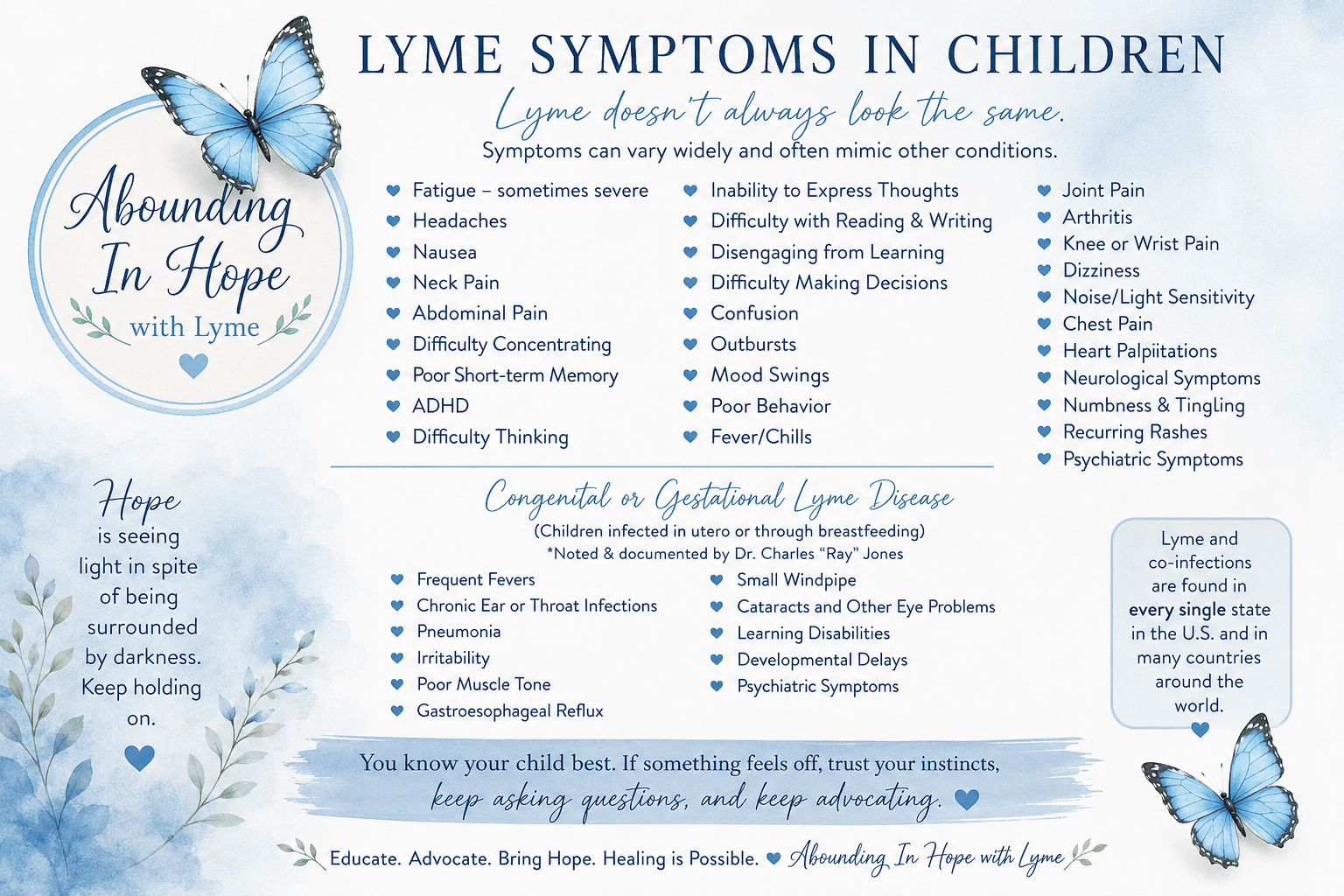
Children often struggle to explain how they feel, which can make diagnosis even more challenging. Parents may simply notice their child becoming unusually tired, withdrawn, emotional, or less interested in playing with friends and participating in normal activities. Early symptoms may include headaches, stomachaches, dizziness, motion sickness, joint pain, sleep disturbances, mood changes, sensory sensitivities, or trouble concentrating in school. (LymeDisease.org)
Lyme-literate doctors also emphasize that ticks can carry multiple infections at the same time. In addition to Lyme disease, children may contract coinfections such as Babesia, Bartonella, Ehrlichia, Anaplasma, or Mycoplasma. These infections may contribute to more complex symptoms, including foot pain, muscle spasms, migraines, anxiety, urinary frequency or incontinence, neurological symptoms, behavioral changes, and severe fatigue. (ILADS)
Another concern raised by ILADS-affiliated practitioners is that standard testing may miss cases, especially early in the illness. The Children’s Lyme Disease Network notes that common Lyme tests can produce significant false negatives, which may delay diagnosis and treatment. (childrenslymenetwork.org)
For parents, recognizing subtle changes in a child’s physical, emotional, or cognitive health after possible tick exposure can be important. Many families report that early symptoms were initially dismissed as stress, growing pains, viral illness, anxiety, or behavioral issues before Lyme disease or another tick-borne infection was considered.
All four of my children have had chronic Lyme disease, and one of my children subsequently had PANS (Pediatric Acute-onset Neuropsychiatric Syndrome). I struggled for several years to get an accurate diagnosis for them. Two of my children had known deer tick bites, but no other initial symptoms. One daughter never had a tick bite that we knew of, only a spider bite. My son developed mild symptoms shortly after birth.
I took two of my daughters to the pediatrician each time they were bitten by a deer tick, and each time, I was given false information, which I believe led to them becoming chronically ill and missing out on most of their childhood and teen years. The first time I went to the pediatrician, I was told that my daughter could not get Lyme disease because the tick was not attached for more than 24 hours. Now I know that it does not take 24 hours for a tick to transmit a Lyme infection.
Do Not Take This for Lyme Disease
The pediatrician prescribed for her to have exactly two Doxycycline pills as a precaution. She called it prophylactic treatment and said that it would kill any infections and she would be fine.
I want to be clear! This does nothing to prevent infection and can alter a Lyme disease blood test, but I did not know that at the time. I took my other daughter to the pediatrician because she had an odd rash that appeared about a week after I removed a tick. Our pediatrician told us that she did not have a bull’s-eye rash and therefore could not have Lyme disease.
Only 50% of infections produce a rash, and 50% of those rashes are a classic bull’s-eye.
As a Mom, I want to know why our pediatricians are not being taught the correct information about tick-borne diseases. Why are they not taught to recognize an early Lyme infection so that our children don’t become chronically ill? Why don’t they know the proper treatment protocols? And why are they not taught to trust a mother’s intuition?
The Impossible Request for Lyme Treatment
Instead, I was thrown the CDC “Bible” stating that there’s no such thing as chronic Lyme disease and that a Lyme infection must have a bull’s-eye present.

When I learned that I had chronic Lyme, I began to recognize similar symptoms in my children. I was heartbroken and angry because I knew it could have been prevented.
When my youngest daughter later began struggling with psychiatric symptoms, OCD, anxiety, learning difficulties, and behavioral problems, I started researching Lyme disease in children. The more I read, the more her symptoms matched what many families were describing.
I brought my concerns to our pediatrician, but once again, I was assured it couldn’t possibly be Lyme disease. Instead, I was handed a list of parenting books to read.
But deep in my heart, I knew my child was suffering, and I continue advocating for her.
I decided to pursue testing through the Lyme doctor I had found for myself. We tested her through MDL Labs, and the results confirmed what I had suspected all along — she had Lyme disease along with Bartonella and Babesia coinfections.
I quickly learned that I needed to take my daughter to a doctor who truly understood the complexities of tick-borne diseases and how differently they can present in children.
Doctors do not know everything, and many are simply not being trained to recognize the widespread reality of Lyme disease and other tick-borne infections, even though now there is so much more information about it. Lyme-carrying ticks and coinfections have been found in every state across the United States and in many countries around the world.
If you, as a parent, are not educating yourself about Lyme disease and tick-borne infections, you could very easily miss the opportunity to identify and treat an infection before it becomes chronic in your precious child.
Here are key symptoms to help you identify a Lyme infection in your child.
Pregnancy and Breast Milk
It is controversial as to whether or not a mother can pass Lyme disease to their unborn child or through breastfeeding. Many Lyme-literate physicians have found that Lyme indeed can be transmitted through pregnancy and breastfeeding.
When I was pregnant with my son, I began having symptoms that I now know were from Lyme disease. Thankfully, we know that my son has had Lyme disease, and his symptoms were mild, but because we were aware, we were able to have him treated appropriately. No parent wants to see their child suffer. My children have lost so much of their childhood and of their critical teen years by being sick with this painful and devastating disease.
Ask your pediatrician what their views are about Lyme disease. Some doctors are willing to give the appropriate dosage of medication when a tick has been found. You do not need to be at the mercy of your pediatrician.
My preferred and recommended way to treat every tick bite is with herbs or homeopathy. I have been using homeopathy for tick bites for the past 10 years with great success.
ILADS recommends treating every tick bite with 21 days of Doxy and longer if there are any symptoms at all.
Some pediatricians will even offer to send the tick off for testing so that you can find out whether or not an infection is even possible. Testing ticks was once thought to be more accurate than human testing. If you choose to test your tick, choose a lab that is close to your home and be sure they are not backlogged. If your tick is engorged and it takes too long for testing, it can disintegrate before it’s able to be tested.
If there’s one thing I’d like to encourage you to do, it’s that you dedicate a little of your time to understanding what Lyme disease is and how to recognize an early infection or a chronic infection to get the proper diagnosis and treatment.
For further reading and research
Lyme Disease.org Pediatric Tick-borne Disease Specialists
LymeNet Neurological Neurological Manifestations of Lyme Disease in Children
Lyme Disease Association Tick-Borne Disease in Children and Adolescents
Gordon Medical Associates Children At Risk for Lyme Disease
IGENIX.com The Psychological Effects of Lyme Disease
Psychology Today Lyme Disease: The Great Imitator, Pamela Weintraub


Hi, do you know of any financial assistance for Lyme patients? I’ve had Lyme for 17 years with only a few flares, but this most recent one has been over two years long! I have a naturopath and LLMD, but I can’t see them as often as I should, because we are only on my husband’s income with me being sick. Even if I could make the appts, we can’t afford the necessary supplements. (Was on Cowsen protocol that seemed to work, but I couldnt afford more than two months of the tinctures). Also, my 14 yr old has symptoms, so I have given up persuing my healing so that she can be tested and taken care of. We had to use our credit card for some of my treatments the past two years, so we are left with some debt and me still sick. Anyway, glad your children are doing well. Thanks for sharing your experience and offering advice.
Teri from CT
Hi! Hugely helpful article! I know at least one of my kids is symptomatic. Can I ask how your kids are doing now after treatment?
Hi Theresa, once we found our alternative doctor they began improving. They are all doing very well! My oldest girls have graduated, one went to college and all 3 are working. My youngest is pretty much amazing compared to where she was. It truly is remarkable. She was able to work as a Nanny, now she is taking dual credit for her senior year of high school and she’s working and plans to travel and attend college after high school. I’m not sure it’s ever possible to get to a 100% but they sure are functioning as though they are. We all have to stay on top of our health which is great for a long, healthy life anyways! ?
Thank you so much for your reassuring reply and for helping to de-mystify this frustrating and debilitating puzzle. God bless
What specific blood tests did you request to identify lyme positive? Our 5.5 year old presented with the bullseye rash this summer and was treated with 21 days amoxicillin, but we’d like to test her to find out if it was effective. Thanks so much!
Hi Lauren, one daughter tested posited through Labcorb with the Western Blot. My son and 3rd daughter tested through a lab called MDL using a Western Blot and my oldest daughter was tested through auricular energy testing. The 3 that did labs were not CDC positive but our doctor was an LLMD so she knew that you only need 1 band along with symptoms to be positive. Lyme and co-infections should always be a clinical diagnosis per the CDC. From my research, a bulls-eye means Lyme only 25% of Lyme infections produce a bulls-eye) and the only way you truly know if it was effective is if she no longer has symptoms. Blood tests are grossly unreliable. If any symptoms recur or new symptoms show, think Lyme or coinfections. I hope that helps.
Would you treat a child if positive for Lyme but no symptoms?
Hi, Jada, it’s very important to discuss this with a practitioner who is knowledgeable about Lyme and coinfections. There are many symptoms that may not be attributed to the infections but are a result of them. It also really depends on what type of treatment you are pursuing. Personally, with homeopathy, we address things that are currently active as well as things we want to protect against. I’m not a doctor but personally, I would never treat with antibiotics if there aren’t symptoms. I hope that helps.